

7 Tips to Improve Productivity at Work

7 tips to improve your productivity at work
August 7, 2026
By Hamster | Buro & Cie
Between overflowing emails, meetings, urgent requests and multiple projects to manage, it is easy to end your day feeling like you did not accomplish everything you planned. However, being more productive does not necessarily mean working more. Often, a few adjustments to your work environment and habits are enough to improve your efficiency.
Whether you are an entrepreneur, manager or office employee, discover 7 simple tips to improve your productivity at work and make the most of your days.
1. Create a suitable workspace
Your work environment directly influences your concentration, comfort and efficiency. A poorly organized desk, an unsuitable chair or a non-ergonomic workstation can quickly lead to physical and mental fatigue.
Investing in an ergonomic workspace helps promote better posture, reduce discomfort and create an environment that encourages concentration. A suitable office chair, monitor stand, footrest or adjustable desk can make a real difference in your daily routine.
For businesses, providing a comfortable work environment also contributes to employee well-being and team performance.
Discover our selection of office furniture and ergonomic accessories.
2. Apply the 2-minute rule
Popularized by David Allen in his book Getting Things Done, the 2-minute rule is simple: if a task takes less than two minutes to complete, do it immediately.
Replying to a quick email, confirming an appointment, filing a document or sharing information with a colleague are all small actions that can quickly pile up when they are constantly postponed.
By completing them immediately, you reduce the number of pending tasks and prevent them from unnecessarily occupying your mental workload.
3. Focus on one task at a time
In a world where notifications are everywhere, multitasking may seem unavoidable. However, constantly switching from one task to another often reduces work quality and increases the time needed to complete each activity.
When working on an important task, try to limit interruptions. Close unnecessary tabs, mute notifications and set aside dedicated work periods.
By focusing on one task at a time, you will reduce errors, improve efficiency and complete your projects faster.
4. Determine your priorities
Not all tasks are created equal. Some have a direct impact on your goals, while others can wait or even be delegated.
To better manage your time, use the Eisenhower Matrix, a prioritization method that classifies tasks according to their importance and urgency.
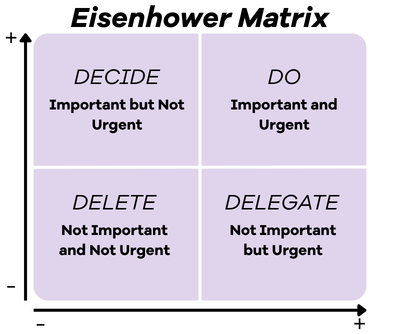
Eisenhower Matrix for task prioritization
Tasks are divided into four categories:
- Urgent and important: complete immediately.
- Important but not urgent: schedule for later.
- Urgent but not important: delegate whenever possible.
- Neither urgent nor important: eliminate or postpone.
This method helps you focus your efforts on activities that truly generate value rather than simply reacting to the urgent matters of the moment.
5. Set clear and precise goals
It is much easier to stay motivated when you know exactly what you are trying to accomplish.
Define realistic, measurable goals with a clear deadline. Whether it is reaching a sales target, completing a project or improving an internal process, precise goals allow you to track your progress and maintain your motivation.
To visualize your goals and priorities, using a whiteboard, a wall calendar or a planner can be particularly effective.
Discover our organization and planning solutions for the office.
And why not plan a small reward when you reach an important milestone? This simple strategy can help maintain your long-term commitment.
6. Use technology to your advantage
Technology can become a powerful ally when used strategically.
Collaboration tools, project management platforms, shared calendars and artificial intelligence solutions can help automate repetitive tasks and save valuable time.
For example, AI tools can help with:
- Summarizing meeting notes;
- Generating email drafts;
- Structuring projects;
- Organizing complex information;
- Creating quick document summaries.
The goal is not to replace human expertise, but rather to reduce the time spent on administrative tasks so you can focus on higher-value activities.
7. Take regular breaks
Taking a break may seem counterproductive when you have a lot to accomplish. However, breaks are essential for maintaining your concentration and energy level throughout the day.
After an intense period of work, take a few minutes to stand up, walk, stretch or simply change your environment. These moments allow your brain to recover and help you approach your next task with better focus.
You can also try the Pomodoro technique, which consists of alternating focused work periods with short breaks. This method is particularly appreciated by professionals who want to maintain a good level of productivity without burning out.
In summary
Improving productivity at work does not rely on a miracle solution, but rather on adopting good daily habits. An ergonomic workspace, effective priority management, clear goals, smart use of technology and regular breaks can have a significant impact on your performance.
At Hamster | BURO & CIE, we support businesses in designing their workspaces and selecting the supplies, furniture and technological tools that promote everyday efficiency.
Need advice on optimizing your work environment?
Contact our team or visit one of our locations to discover solutions tailored to your professional needs.
Contact us